Atiyyah Khan at SJQ
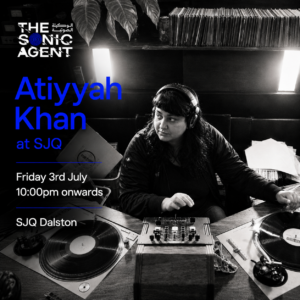
Join us for an unforgettable evening with Atiyyah Khan, the Cape Town-based DJ, arts journalist, researcher and sound practitioner.
Drawing on 18 years of documenting South Africa’s arts and culture, Atiyyah brings a rich, thoughtful approach to sound, storytelling and collective listening. Her work explores spatial injustice, hidden apartheid histories, jazz legacies and underground art movements, while her DJ sets move effortlessly through jazz, African and Latin groove, SWANA rhythms, dub, reggae, gnawa, cumbia, taarab, hip-hop, rhumba and global beats.
As co-founder of Future Nostalgia, a collective connecting collectors, selectors, DJs and diggers across South Africa, she creates spaces where music becomes memory, archive and shared experience.
Expect a deep, warm and expansive selection shaped by years of listening, writing and digging.
This is an invitation to gather, listen closely, move and dance together!
Free entry, with limited tickets! Get yours fast!
Get your tickets HERE.
The Craft of Writing About Music & Sound

In the framework of Beirut & Beyond International Music Festival’s series of technical workshops meant to support and develop the local music scene, this workshop is designed for aspiring/rising music writers and researchers, developed and led by Christina Hazboun (aka The Sonic Agent – writer, researcher, creative) and Pierre France (scholar, writer, researcher).
It is aimed at all Lebanon-based individuals with an interest in music, specifically those with basic prior knowledge in the fields of cultural writing and research.
ABOUT THE WORKSHOP
- Dates: 1-3 December, 2025
- Time: 5-8 PM
- Workshop language: English
- Output languages: English, French or Arabic (personal choice)
- Level: Flexible
Practical implementation during BBIMF 2025 for selected participants.
MEET THE WORKSHOP LEADERS
About Christina Hazboun
Christina Hazboun is a writer, researcher and practitioner within the spheres of text, sound, radio and music morphing through sonic spaces, striving to increase the volume on the whispered, silenced and erased. She does so under the umbrella of The Sonic Agent, where she also conjures live events and tours to increase the visibility and audibility of music and sound from the SWANA.
Her chapter “Sonic Strategies in The Palestinian Struggle” appears in the Silver Press “BODIES OF SOUND: Becoming a Feminist Ear” and Transcript Verlag’s “Beyond Molotovs”. Her texts and audio/radio works endeavour to document Palestinian music and soundscapes, while also focusing on the global south. Her audio works appear on platforms like Stegi Radio, Radio Al-Hara, Culture Resource.
Her texts are anarchived in the digital universe including Bandcamp, The Guardian, The Quietus, Herri Magazine, Bloomsbury Press, Middle East Eye, The New Arab and the upcoming Trigger issue and more.
Christina is also the UK project manager of global music and gender initiative Keychange at PRS Foundation.
About Pierre France
Pierre France studied sociology, political science, and musicology, and has been writing about music for over a decade, both as a researcher and a writer (and sometimes DJ under the name analfabet). His work combines a meticulous attention to musical material with a grounded analysis of its economic and social infrastructures. It appeared in publications such as Middle East Eye, Orient XXI, Vacarme, Ma3azef, Legal Agenda, and Musique Journal.
A recent fellow at Stanford University, the Marc Bloch Center (Berlin), the Max Weber Stiftung (Beirut), and the Camargo Foundation (Cassis, France), he is completing a PhD and developing a forthcoming book project. Based between France and Lebanon since 2011, he is regularly consulted by media outlets including Reuters, le Figaro, L’Orient-Le Jour, France Culture, and France Inter for his expertise.
Recently, he completed two major studies: one quantitative, analysing two years of music charts across Arab countries to explore listening habits and popular taste; and another historical, tracing the rise and influence of the still powerful music and financial conglomerate Rotana (Regards, forthcoming 2025).
This workshop is free of charge and is part of the MASAR program, and is funded by the Institut Francais du Liban.
Don’t Call Me Baby: Etaf’s Debut Album Launch

“Don’t Call Me Baby” is the powerful culmination of Etaf’s works brought together through innovative collaboration, collective queering and visionary expressionism. Etaf will be performing the album live in full, for the first time ever, inviting all free spirits of equity lovers to come under one roof, listen, move, shake, sing and dance to the queer utopian bangers that their album brings to East London’s The Orange Room.
The night will also feature a number of very special guests.
Let’s all come together to cherish the music and the moment.
******
Etaf is a Kuwaiti singer-songwriter and multi-instrumentalist based in London. Genre defying and unapologetically iconic, Etaf has carved out a distinct musical identity that is daring and innovative. Drawing on traditional Khaleeji sounds and rhythms, they seamlessly integrate rich Arabic scales, beats and melodies into contemporary music, creating a soundscape that is both familiar and refreshingly new.
******
Accessibility:
There is step-free access via ramp at the most accessible entrance. There is step-free level access throughout